
Top Trends in AI-Driven Social Experiences for Adults
Social platforms powered by AI for adults have moved beyond being tools for experimenting with ideas or tweaking concepts that are not yet finished. They are crystallizing into a defined format that represents the authentic behavior of the users. Typically, adults interacting with these platforms are more likely to prefer order rather than randomness and understanding rather than continuous arousal. Therefore, the emphasis of the layout has been changed to provide users with control over the direction of the conversations, limiting the exposure of personal data, and retaining regular interaction patterns.
This evolution reflects a clear shift in user behavior. Many adults are stepping away from spaces that feel performative or emotionally demanding and choosing systems that respond to their preferences rather than challenge them. Platforms such as go love ai align with this direction by emphasizing interaction that adapts to personal limits, allowing users to engage on their own terms without pressure to impress, compete, or keep up with external expectations.
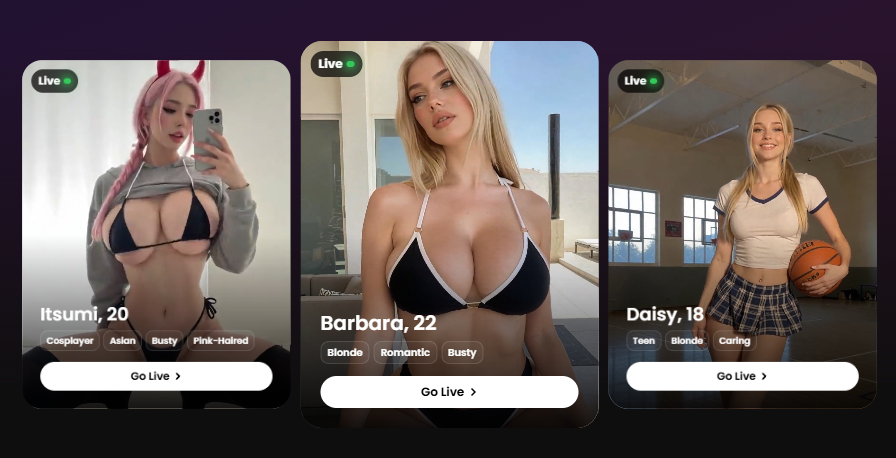
What follows is a focused look at the most relevant trends defining AI-powered social experiences for adults today, without speculation or inflated claims.
How AI Is Reframing Adult Social Interaction
Adult social experiences powered by AI are developing along a different path than mainstream social networks. Visibility, public metrics, and competitive attention loops are losing relevance here. In their place, platforms emphasize private interaction, adjustable pacing, and consistent behavioral logic from the system itself.
This change reflects a broader move toward selective digital engagement. Adults who spend significant time online already understand the cost of unmanaged interaction. AI-driven systems respond to that awareness by reducing randomness and removing social penalties tied to silence, hesitation, or changing preferences.
The result is a category that feels intentional rather than reactive. Users engage because they choose to, not because an algorithm pushes them into constant participation.
Personalized Adult AI Companionship as a Core Trend
Adult AI companionship platforms, such as emotion-aware AI interaction environments designed for adults, are increasingly built around adaptive behavior rather than scripted responses. This trend goes beyond surface-level customization and moves into dynamic interaction patterns shaped by user input over time.
Instead of presenting a fixed persona, modern systems adjust tone, response length, and conversational depth based on how the user engages. This allows interaction to evolve without forcing escalation or artificial intimacy. The adult audience values this adaptability because it respects personal limits and avoids assumptions.
Privacy-First Design Becomes a Non-Negotiable Standard
Privacy is no longer a feature that differentiates adult AI platforms. It is an entry requirement. Users engaging with AI-driven social experiences expect clear separation from public identity, searchable profiles, and external validation systems.
Several design patterns are becoming standard across the category:
- Minimal data exposure by default, with user-controlled visibility.
- No public interaction history or performance metrics.
- Clear session boundaries that prevent unintended continuity.
- Limited data retention aligned with functional necessity.
These elements reduce psychological overhead. When users understand that interaction remains contained, engagement becomes more deliberate. This is particularly relevant in adult contexts, where discretion often determines whether a platform feels usable at all.
AI as a Structured Alternative to Social and Dating Apps
Traditional social and dating platforms rely on unpredictability. Matches, responses, and visibility fluctuate based on opaque systems. AI-driven adult social experiences move in the opposite direction by offering consistent interaction rules.
This predictability appeals to users who are disengaging from platforms that demand constant signaling and interpretation. AI does not misread pauses. It does not impose social consequences for disengagement. That reliability creates space for interaction that feels intentional rather than transactional.
Rather than replacing human connection, these platforms occupy a separate category. They function as controlled environments where users can engage socially without negotiating status, timing, or mutual expectations. GoLoveAI operates within this space by focusing on structured interaction rather than simulation of real-world dating dynamics.
Emotional Boundaries Are Designed, Not Assumed
Another defining trend is the explicit design of emotional boundaries. Earlier AI systems often blurred lines between companionship and dependency through vague messaging. Current platforms take a more defined approach.
Boundaries are communicated through interface choices, pacing mechanics, and response framing. This allows users to understand what the interaction is and what it is not. Adult users tend to respond positively to clarity. When expectations are managed at the system level, engagement feels safer and more sustainable.
This approach also supports healthier usage patterns. By avoiding emotional escalation mechanics, platforms reduce the risk of over-attachment while still offering meaningful interaction.
Where These Trends Are Leading Adult AI Social Platforms
AI-driven social experiences for adults are slowly lining up in a similar direction. The shared thread is not scale or novelty, but a set of principles that people keep responding to. Users naturally expect to decide how and when they will interact, to be able to rely on consistent systems, and to recognize that privacy is a fundamental feature, not an afterthought. Also, clear emotional framing is important. If there is ambiguity, people are usually going away instead of coming in.
If we look into the future, the breakthrough in this field will probably be from accuracy rather than growth. A more accurate recognition of the context. Finer changes in mood and pace. A better match between what a user desires at any given moment and how the system reacts. Those platforms that commit to such elements almost always get the users’ attention by being unobtrusive, not by promising more.
Within this category, restraint has become a measure of quality. Adult users are not searching for constant stimulation or dramatic experiences. They gravitate toward environments that treat time and attention with care and acknowledge personal boundaries. AI-driven social spaces that follow this path are building a space defined by intention, not impulse.